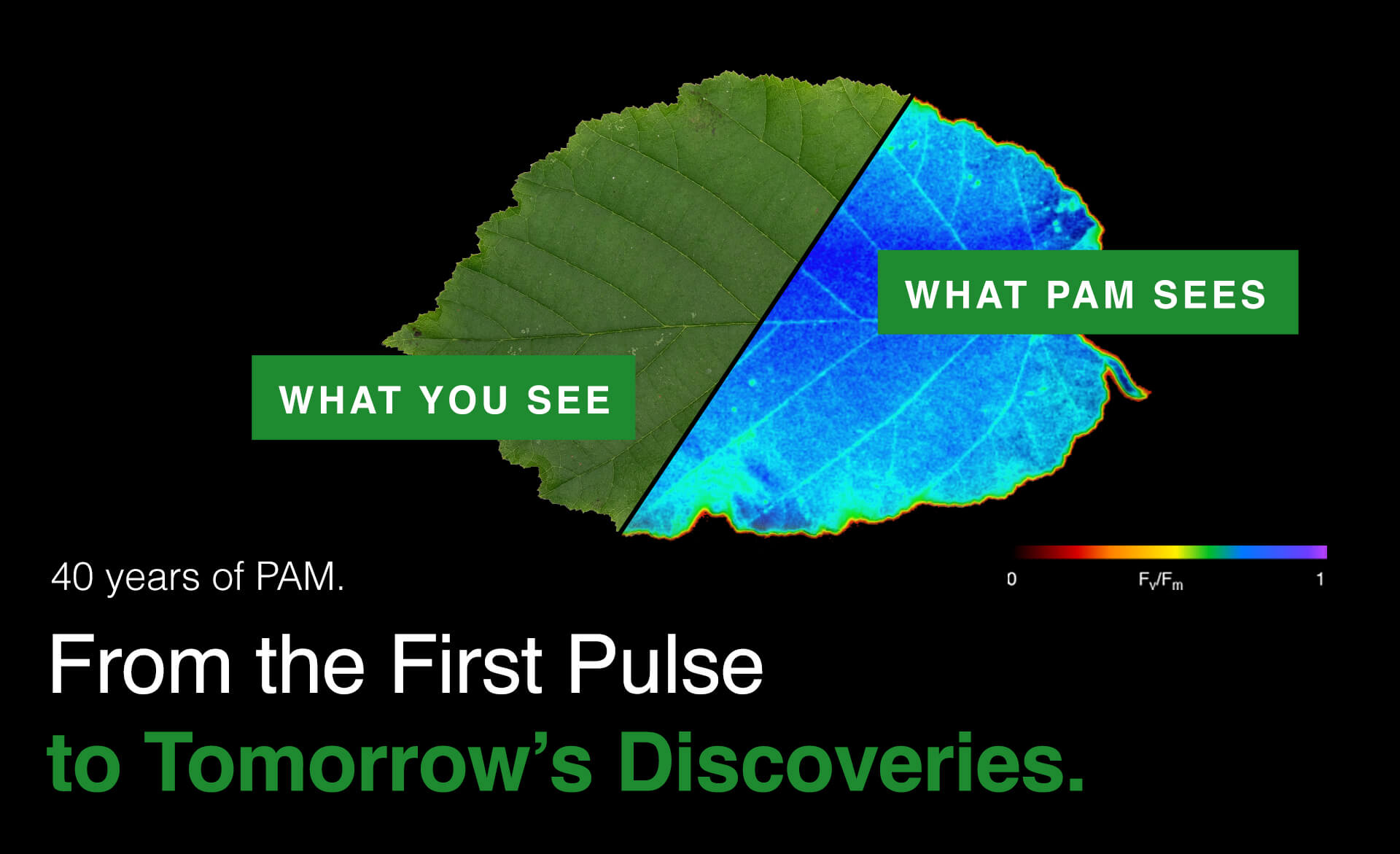
"What you see. What PAM sees. For four decades, Pulse-Amplitude-Modulation (PAM) has made the invisible measurable."
Four Decades of Innovation in Chlorophyll Fluorescence Research
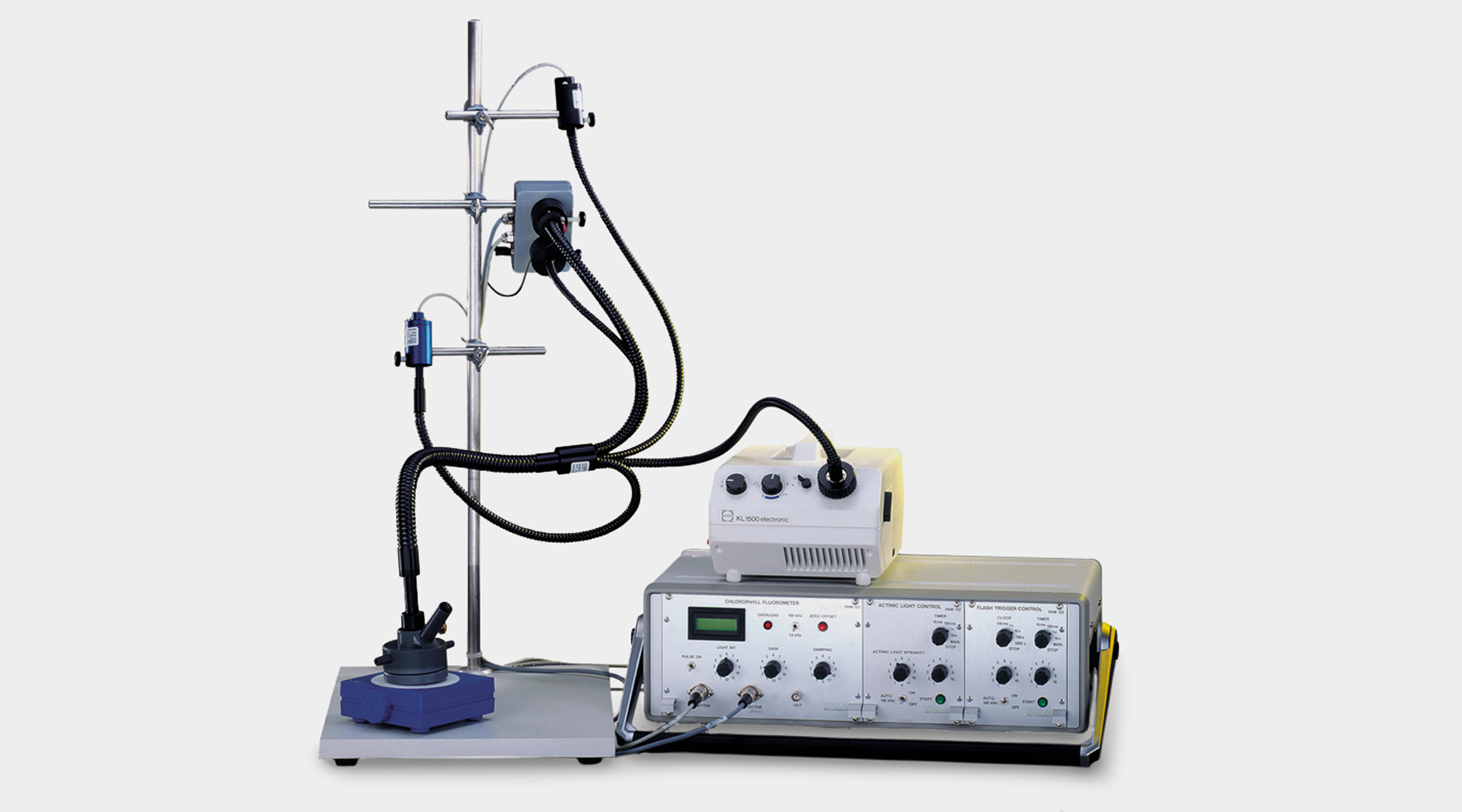
Since its introduction in 1986, pulse-amplitude-modulated (PAM) chlorophyll fluorescence technology has become an established method for investigating photosynthetic processes. The development of the first commercially available PAM chlorophyll fluorometer, the PAM-101, by Heinz Walz GmbH marked an important milestone in the application of chlorophyll fluorescence analysis to photosynthesis research.
Based on the pioneering work of Prof. Dr. Ulrich Schreiber, PAM fluorometry introduced a highly selective approach to measuring chlorophyll fluorescence under ambient light conditions. By separating modulated measuring light from continuous actinic illumination, the technique enabled the determination of chlorophyll fluorescence parameters under a wide range of experimental conditions. Over the following four decades, this fundamental measurement principle has been continuously refined and extended, resulting in a broad range of instruments designed to address increasingly specific scientific questions.
Continuous technological development
The evolution of PAM technology has been driven by advances in both photosynthesis research and measurement technology. Progress in optoelectronics, light-source technology, signal detection, data acquisition and instrumentation has enabled increasingly sophisticated measurement approaches. At the same time, new scientific requirements have stimulated the development of specialized instruments for different biological systems and experimental environments.
The resulting product portfolio encompasses instruments for laboratory and field applications, terrestrial plants, algae and phytoplankton, as well as aquatic and submerged photosynthetic organisms. Further developments have extended conventional point measurements to spatially resolved fluorescence imaging, long-term monitoring and simultaneous investigations of different photosynthetic processes.
Driven by scientific questions
The development of PAM technology has always been closely connected to the evolving requirements of photosynthesis research. New scientific questions frequently require measurement approaches that go beyond the capabilities of existing instrumentation. These requirements have provided important impulses for the development of new optical configurations, excitation protocols, detection systems and analytical concepts.
Consequently, the history of PAM technology is not simply a sequence of improved instrument generations. It reflects the progressive expansion of experimental possibilities in the investigation of photosynthetic function, regulation and environmental responses. The interaction between scientific research and instrument development remains a central element of the Walz philosophy: translating new scientific requirements into practical and reliable measurement solutions.
Looking towards the future
After four decades of continuous development, PAM technology remains an important and evolving tool in photosynthesis research. New research questions, emerging experimental approaches and advances in measurement technology will continue to create opportunities for further innovation.
Building on four decades of experience, Heinz Walz GmbH remains committed to advancing fluorescence-based measurement techniques and developing instrumentation that supports the next generation of research into photosynthesis.