MICROFIBER-PAM
Probing of Cells and Tissue in Microbial Mats and Leaves
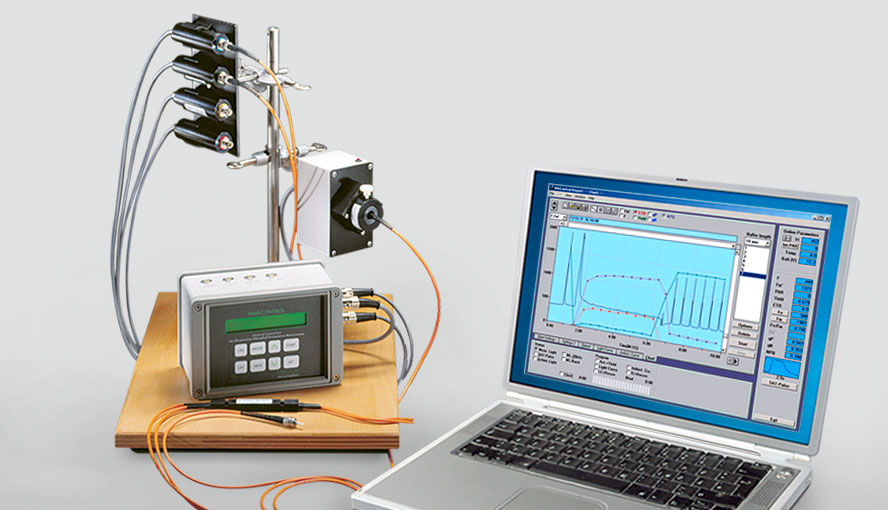
The MICROFIBER-PAM employs thin (100 µm) optical fibers for fluorescence excitation and detection. The thin fiber allows probing of small spots of heterogeneous photosynthetic surfaces like soil crusts.
A “working fiber” (MF-F, accessory), which is inserted into a leaf or a photosynthetic mat, measures photosynthetic gradients inside the sample. For easier penetration, the working fiber can be pulled out to a tapered tip of 10 to 30 μm.

Outstanding Properties of the MICROFIBER-PAM
PAM fluorometer with the thinnest fiberoptics cable
Ultrahigh sensitivity
Four measuring light colors available
Measurement of light attenuation
The fiberoptics system of the MICROFIBER-PAM consists of two pairs of optical fibers. A fiberoptics coupler optically connects the fibers. Two fibers link the light source and the photomultiplier, respectively, to one end of the fiberoptics coupler. The two other fibers link the sample to the opposite end of the fiberoptics coupler.
For fluorescence measurements, the fiber optic coupler guides light from the LED via a single fiber to the sample, and it transmits the fluorescence emitted by the sample to the photomultiplier. Color filters prevent LED light from reaching the photomultiplier. To measure light attenuation, the two sample fibers are placed at opposite sides of the object of study and color filters are removed (see Figs. 1 and 2 below).
Fluorescence excitation and detection are controlled by the PAM-CONTROL unit, which allows stand-alone operation of the MICROFIBER-PAM but also functions as an interface for operation of the system by a Windows computer.
The PAM-CONTROL unit can be operated by the WinControl software versions 2 or 3. The system includes, an RS-232 cable, a USB-RS-232 adapter (when an RS-232 port is not available), a charger MINI-PAM/L, a cable to connect a chart recorder, a transport box, and a stand (ST-101).
Functional Diagram MICROFIBER-PAM
Fluorescence measurement (Fig. 1): Blue light passes through a short-pass filter transmitting light only at wavelengths smaller than 600 nm (MF-L470). A fiber guides the LED light to the four-port fiberoptic coupler, MF-2-2-100. Another fiber directs the LED light from there to the sample, and guides fluorescence back to the fiberoptic coupler. LED light and fluorescence are then transmitted fiberoptically to the photomultiplier (PM-MF).
Only fluorescence light reaches the photomultiplier because it is protected against the blue LED light by long-pass filters transmitting light only at wavelength longer than 640 nm. The fiber adapter for the photomultiplier is part of the MICROFIBER-PAM adapter set, MF-A. The MF-A adapter set also includes a holder for the blue LED and three additional LEDs.
Light attenuation measurement (Fig. 2): Without the color filters in front of the LED and the photomultiplier, and with face-to-face orientation of the tips of the two sample fibers, the MICROFIBER-PAM detects the blue measuring light transmitted by the fiberoptics system to the photomultiplier. A sample placed between the fiber tips reduces the blue light intensity reaching the photomultiplier. The degree of light attenuation by a sample can be derived from the photomultiplier signal.


PAM-CONTROL Universal Control Unit
The PAM-CONTROL unit can be used to carry out PAM fluorescence measurements independently of a computer but it also acts as interface between fluorometer and a Windows computer running the version 2 or 3 of the WinControl software.
The PAM-CONTROL unit is part of several PAM systems, which all employ a highly sensitive photomultiplier tube for fluorescence detection: the MICROSCOPY-PAM, the MICROFIBER-PAM, and the WATER-PAM FIBER Version. In all three systems, an automatic shutdown procedure protects the photomultiplier tube against damage by high fluorescence levels or external light.
The memory of the unit can store 4000 data sets. An extensive menu provides full control of instrumental settings and a variety of measuring protocols.


An option that the MICROFIBER-PAM offers is the investigation of gradients of photosystem II characteristics within the leaf. For such investigations, the pointed tip of a working fiber (MF-F) is advanced into the leaf tissue by a micromanipulator, and saturation pulse analysis is carried out at defined depths of penetration.
Using this strategy, Terashima and his colleagues have analyzed how strong light of different colors damages photosystem II at various distances from the leaf surface. By measuring the maximum photochemical quantum yield of photosystem II (FV/FM), the authors demonstrated that amplitude as well as leaf gradients of photoinhibition depend on the color of photoinhibitory light.


Scientific Publications using Walz Devices
Source: Google Scholar.
Keywords: (Walz OR Waltz) Effeltrich.
Date: June 22, 2026.
Ʃ = 19642
Source: Google Scholar.
Keywords: (Walz OR Waltz) Effeltrich.
Date: June 22, 2026.
Ʃ = 19642
Selected Publications
Fluorescence and electron transfer of Limnospira indica functionalized biophotoelectrodes.
Photosynthesis Research 162, 29-45
Light environment within a leaf. II. Progress in the past one-third century.
Journal of Plant Research 129: 353-363
Photosynthetic acclimation of Symbiodinium in hospite depends on vertical position in the tissue of the scleractinian coral Montastrea curta
Frontiers in Microbiology 7: 230
Pronounced gradients of light, photosynthesis and O2 consumption in the tissue of the brown alga Fucus serratus
New Phytologist 207: 559-569
Gradients of photoinhibition in the interior of a leaf induced by photoinhibition lights of different colors
Photosynthesis Research for Food, Fuel and the Future. Advanced Topics in Science and Technology in China. Springer, Berlin, Heidelberg
Intra-leaf gradients of photoinhibition induced by different color lights: implications for the dual mechanisms of photoinhibition and for the application of conventional chlorophyll fluorometers
New Phytologist 191: 146-159
Green light drives leaf photosynthesis more efficiently than red light in strong white light: revisiting the enigmatic question of why leaves are green
Plant and Cell Physiology 50: 684-697
Inter-polyp genetic and physiological characterisation of Symbiodinium in an Acropora valida colony
Marine Biology 153: 225-234
Photobiology of endolithic microorganisms in living coral skeletons: 1. Pigmentation, spectral reflectance and variable chlorophyll fluorescence analysis of endoliths in the massive corals Cyphastrea serailia, Porites lutea and Goniastrea australensis
Marine Biology 152: 395-404
Intra-colonial variability in light acclimation of zooxanthellae in coral tissues of Pocillopora damicornis
Marine Biology 149: 1325-1335
Impact of the wasting disease pathogen, Labyrinthula zosterae, on the photobiology of eelgrass Zostera marina
Marine Ecology Progress Series 226: 265-271
Spatial heterogeneity in active chlorophyll fluorescence and PS II activity of coral tissues
Marine Biology 141: 639-646
Bio-optical characteristics and the vertical distribution of photosynthetic pigments and photosynthesis in an artificial cyanobacterial mat
Microbial Ecology 40: 94-103
Measurement of chlorophyll fluorescence within leaves using a modified PAM fluorometer with a fiber-optic microprobe.
Photosynthesis Research 47: 103-109
MICROFIBER-PAM
Base plate, 40 cm x 30 cm
73.5 cm, diameter 1.5 cm
2.8 kg
Accessories
WinControl-3 Software
General Features and Graphical User Interface
The MICROFIBER-PAM can be operated by Windows computers running the WinControl-3 software. The same software operates the fluorometers DIVING-PAM-II, MICRO-PAM, MINI-PAM-II, MONITORING-PAM, and JUNIOR-PAM, PAM fluorometers operated via the PAM-CONTROL interface (MICROSCOPY-PAM, MICROFIBER-PAM and WATER-PAM FIBER-Version) as well as the Universal Light Meter ULM-500.


WinControl-2 Software
General Features and Graphical User Interface
The software WinControl-2 was developed for on-line operation via the interface PAM-CONTROL of the fluorometers MICROSCOPY-PAM, MICROFIBER-PAM, and WATER-PAM FIBER Version. WinControl-2 logs fluorescence data and automatically calculates fluorescence ratio parameters derived from saturation pulse analysis.
The WinControl-2 software runs only on Windows 7 32 bit or older Windows 32 bit operating systems.


Usage
Highlights
- 200 µm diameter optical fiber
- Ultrahigh sensitivity
- Four measuring light colors available
Downloads
- Software: WinControl-3.41_Software
- Manuals & Documentation: JUNIOR-PAM Manual
- Manuals & Documentation: PAM-CONTROL Manual