ULM-500 Light Meter & Logger

Version:

Product

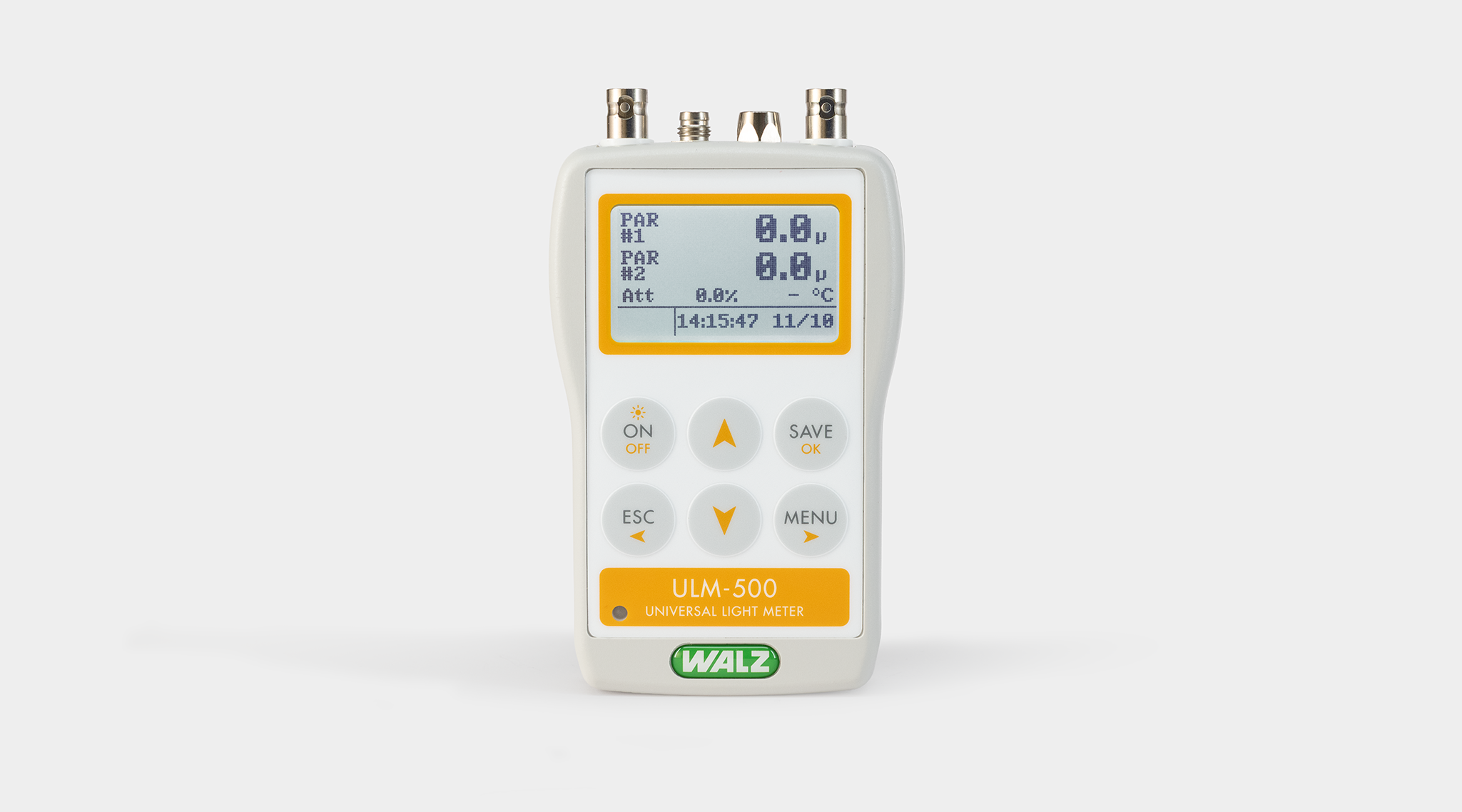
Universal Light Meter & Data Logger
Measuring Photosynthetically Active Radiation for Plant Science

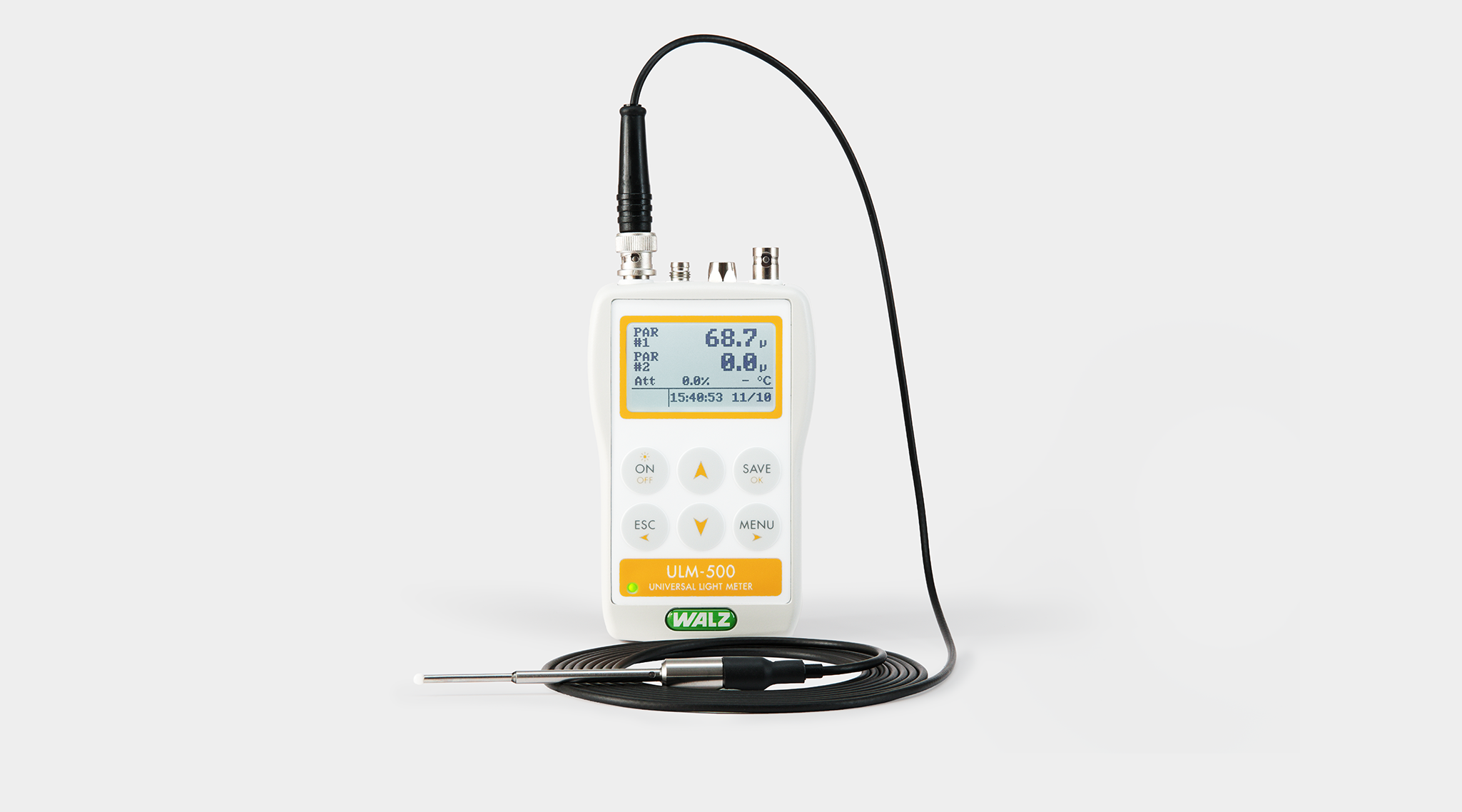
The ULM-500 is a universal light meter and data logger for measuring photosynthetically active radiation (PAR) in air and water. PAR - the photon flux between 400 and 700 nm - is the light that drives photosynthesis and is the most important physical parameter for any plant science experiment involving light.

The ULM-500 measures PAR with a time resolution of up to 100 Hz, a dynamic range spanning five orders of magnitude, and automatic range switching. This makes it fast enough to resolve the saturating light pulses of PAM chlorophyll fluorometers and sensitive enough to capture fast light flecks in natural canopies.

Outdoor use of the ULM-500.

High Dynamic Range for Natural Light and Saturation Pulses

The ULM-500 has 5 sensitivity ranges with fast automatic switching, covering a dynamic range from 0.1 to 99,999µmol m⁻² s⁻¹ even with the smallest PAR sensor available. Range switching can be set to automatic for convenient measurements or to manual for maximum time resolution.

PAR Sensors for Every Measurement Geometry

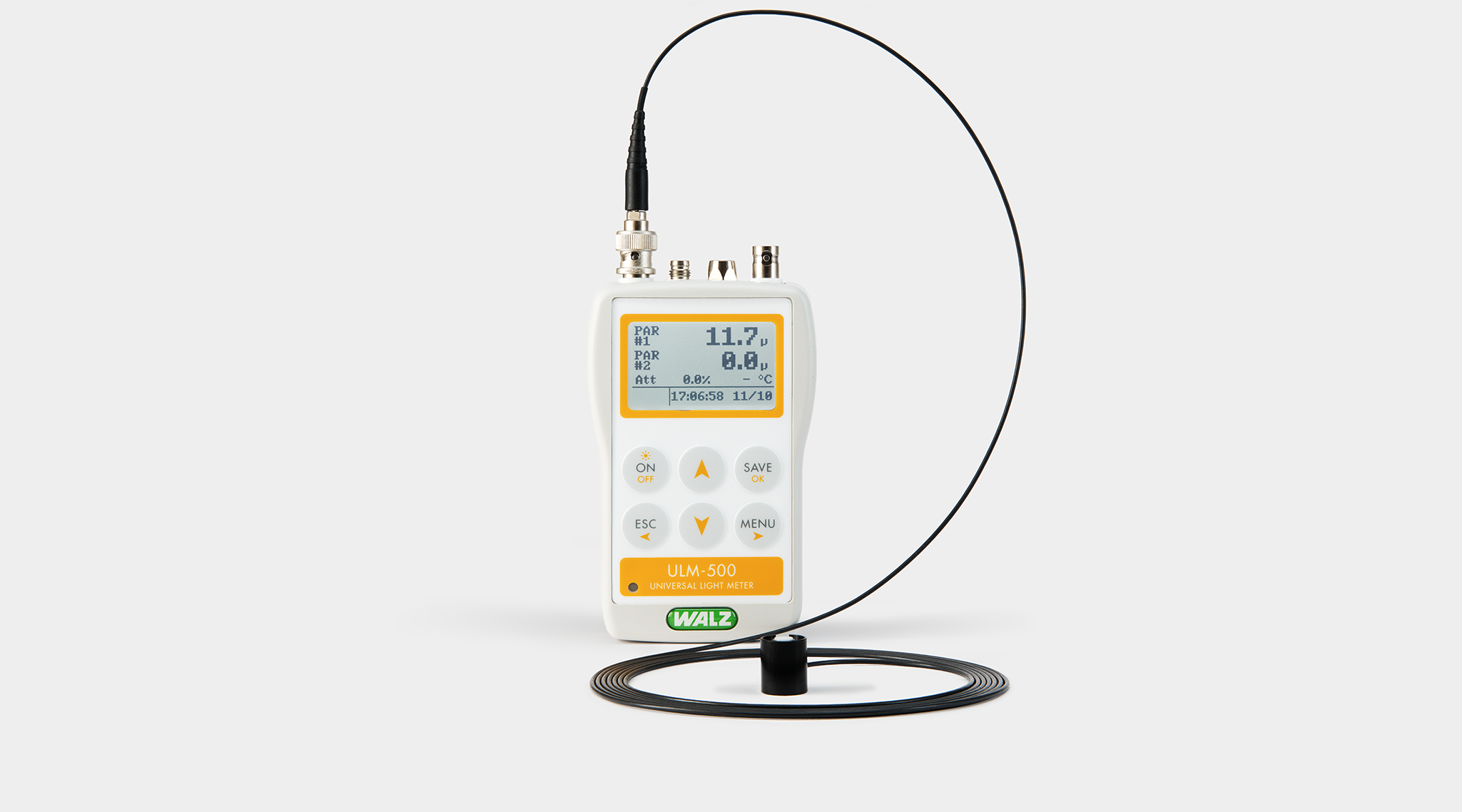
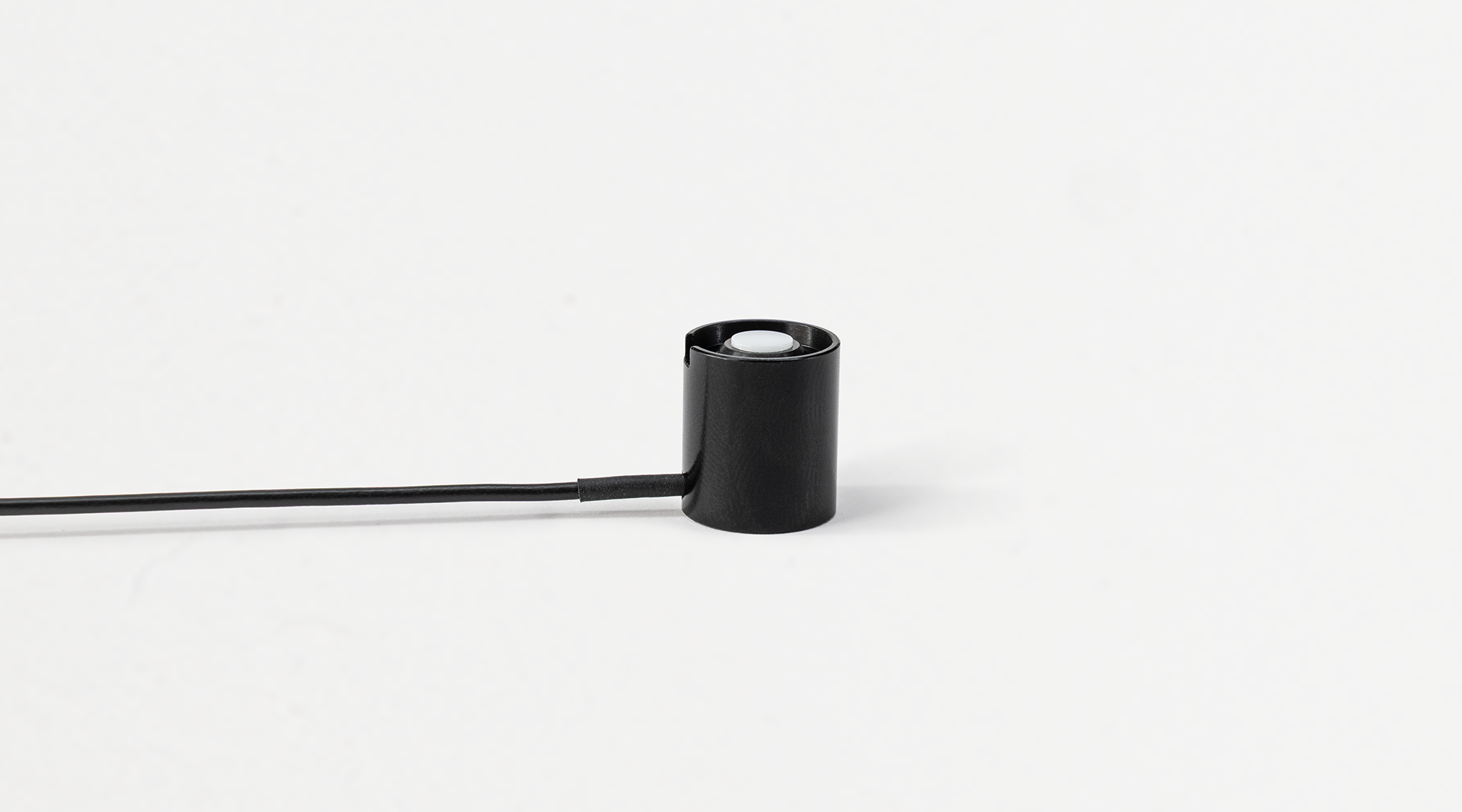
The ULM-500 works with three types of PAR sensors, each designed for a different measurement geometry: The MQS-B Cosine Corrected Mini Quantum Sensor measures photosynthetic photon flux density (PPFD) on flat surfaces with cosine-corrected angular response - the standard photosynthetically active radiation sensor for field and laboratory use. The US-SQS/L Spherical Micro Quantum Sensor measures photon fluence rate omnidirectionally in suspensions and underwater . ideal for algae cultures and aquatic research. The LS-C Mini Quantum Sensor is a compact, waterproof sensor for versatile PAR measurements in tight spaces.

Resolving Fast Light Changes at Up to 100 Hz

Channel 1 is optimized for fast acquisition. In chart mode, a 1.2-second time course with 120 data points is displayed, showing minimum, maximum, and average. The triggered chart function resolves saturation pulses from dark to several thousand µmol m⁻² s⁻¹, usually not possible with standard light meters. Connected to WinControl-3, the ULM-500 provides continuous fast recording of light flecks in natural environments.

High time resolution for the record of saturation pulses of PAM instruments, here the SP of a Phyto-PAM is shown
High time resolution for the record of saturation pulses of PAM instruments (here the SP of a Phyto-PAM is shown).

Built-In Data Logger with 50,000 Data Points

The ULM-500 stores up to 50,000 data points in its internal flash memory. In automated logging mode with sleep function (e.g. one measurement every 5 minutes), batteries last 3- 4 months. Stored data can be downloaded via the WinControl-3 software for analysis or export to spreadsheet programs.

How the ULM-500 Is Used in Practice

Stand-Alone Light Measurement
The ULM-500 operates independently as a PAR sensor with data logger - no computer required. An internal timer triggers continuous measurements at user-defined intervals. The sleep mode minimizes power consumption for long-term field deployments.

Calibration of PAM Instruments
For Walz PAM fluorometers and the IMAGING-PAM system, the ULM-500 provides automated light list calibration and real-time monitoring of actinic and saturation pulse intensities. The high time resolution ensures accurate characterization of even the fastest light pulses.

Attenuation Index
With two BNC connectors for parallel data acquisition, the ULM-500 can calculate an attenuation index using two identical PAR sensors above and below a sample — useful for canopy transmittance studies and leaf area index estimation.

The ULM-500 can continuously measure values triggered by an internal timer. For this purpose no additional computer is necessary.
To save battery power, the instrument has a "sleep mode", i.e. it only wakes up briefly for each measurement.

Using the ULM-500 for a continuous measurement (e.g. one data point every 5 min), the batteries would last for at least 3-4 months (depending on the temperature conditions).

For some of our PAM instruments, we provide sensors for the light-list calibration or for light and temperature measurements during an experiment. If just these sensors shall be used, it can be advantageously to have a small separate instrument like the Universal Light Meter ULM-500 to readout these sensors independently of a PAM.

In combination with the IMAGING-PAM system the ULM-500 can be used for calibration purposes and the recording of the incident light during the experiment. Additionally the ULM-500 is fast enough to determine the intensity of the saturating light pulses.

Since the ULM has two BNC connectors that can be used for parallel data acquisition, it is also possible to use the instrument for a continuous calculation of an attenuation index by using two identical PAR sensors above and below a sample. Another option is the comparison of the characteristics of two different sensors (for example PAR and photometric sensors).

ULM-500 Light Meter & Logger

Design

Light grey plastic housing with connectors, membrane keyboard and a white illuminated LCD graphic display

Dimensions

12 x 7.5 x 3.5 cm

Weight

210 g (including 4 AAA 1.5 V batteries)

Power supply

4 AAA-type batteries or 5 V DC from USB voltage source when connected to the computer

Working conditions

up to 85 % rH (avoid condensation), - 20° to + 50°C ambient temperature

Time resolution

PAR channel #1: 100 samples / second, PAR channel #2 and other channels: 5 samples / second (connected to computer running WinControl-3 software)

Operation time

10 days or ca. 100 days automated logging with sleep mode (1 meas. / 5 min). Unlimited working time via USB connection (PC-software WinControl-3 – no sleep mode)

Inputs
  • Two BNC-connectors for the connection of two PAR-sensors with individual calibration factors between -50.0 and -9999.9 (memory for 10 calibration factors), range switchable in 5 steps 250 nA to 0.6 mA
  • Connector for Monitoring Leaf-Clip JUNIOR-B; an adapter is available for the connection of the Leaf-Clip Holder 2030-B, and the Micro Quantum/Temp.-Sensor 2060-M
  • Connector for additional digital sensors (still under development)
  • USB-Connector for connection with computer (software: WinControl-3)
Memory

Flash memory used as ring buffer for 50000 lines (1 line / single measurement)

Display

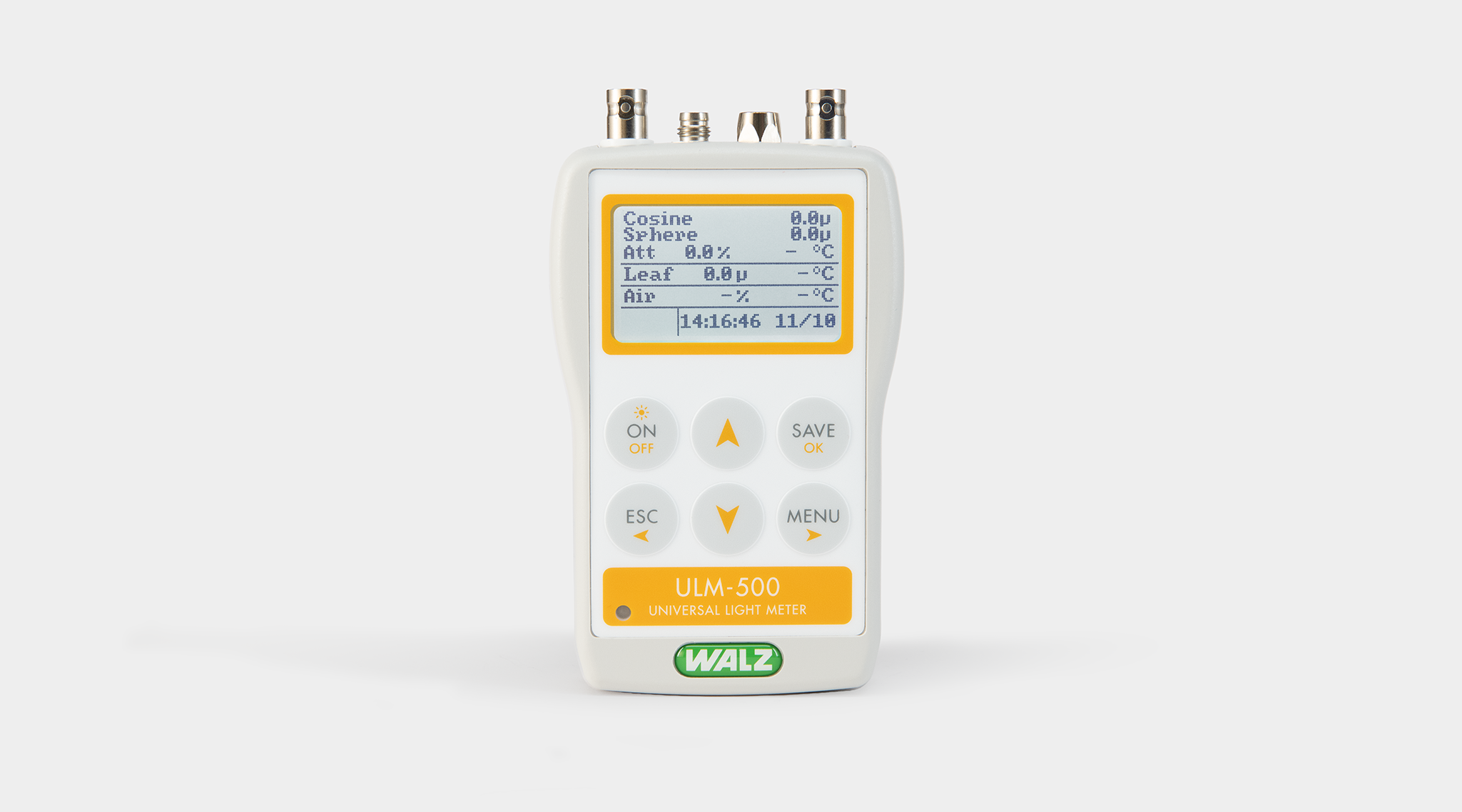
White illuminated graphic display with 5 different display modes (1: all data; 2-4: two selected sensors in big letters; 5: chart mode for channel no. 1, with maximum, minimum and average indicated), resolution: 0.1 μmol m-2 s-1

Computer Connection

1 free USB socket. Processor, 1 GHz. RAM, 256 MB. Hard disc space, 20 MB. Screen resolution: 800 x 600 pixels. Interface, USB 1.1, 2.0 and 3.0. Operating system: Microsoft Windows 10 and 11.

Design of sensor

Mini quantum sensor for selective PAR (photosynthetically active radiation) measurement, cosine corrected for PPFD (photosynthetical photon flux density) measurement.

Sensor housing

Black anodized aluminum housing

Diffuser material

Perspex

Signal detection

High stability silicone photovoltaic detector with filter set for PAR correction (to learn more about the typical sensitivity see “General Features”). Signal output typically -2 μA / (1000 μmol m-2 s-1)

Temperature coefficient of photodiode

0.01 %/K

Absolute calibration

± 5 %

Angular dependence

error < 4 % between angles from -80° to +80° from normal axis

Immersion coefficient

Typically 1.32

Operating temperature

- 5 °C … + 45 °C

Cable length

3 m

Connector

BNC

Power supply

Not required

Size

Height: 16 mm
Diameter: 14 mm
Diffuser diameter: 5.5 mm

Weight

32 g

Program

WinControl-3 System Control and Data Acquisition Program (Microsoft Windows 10 and 11) for operation of measuring system via PC, data acquisition and analysis. Not compatible with Windows 10 on ARM

Saturation Pulse Analysis

Measured: Ft, F0, FM, F, F0’ (also calculated), FM’. Depending on the leaf clip connected, the software can record PAR, temperature and also humidity. [In the case of the MINI-PAM-II clip humidity can be measured, which the clip of the JUNIOR-PAM cannot.]
Calculated: F0’ (also measured), FV/FM and Y(II) (maximum and effective photochemical yield of PS II, respectively), qL, qP, qN, NPQ, Y(NPQ), Y(NO) and ETR (electron transport rate)

Fitting Routines

Two routines for determination of the cardinal points α, Ik and ETRmax of light curves

Programmed Features

Automatic determination of signal offset for all light intensities and gain levels. Automatic calibration of internal PAR sensor against an external PAR sensor connected to the instrument

Computer Requirements

Processor: 0.8 GHz, RAM: 512 MB, screen resolution: 1024 x 600 pixels, interface: USB 2.0/3.0

Communication Protocol

USB

Accessories

Design of sensor

Small versatile waterproof mini quantum sensor for selective PAR measurement, cosine corrected for light incident at an angle between -30 ° to +30 ° from surface normal for PPFD (photosynthetical photon flux density) measurement, with base plate for screw connection.

Sensor housing

Black resin material

Diffuser material

Perspex

Signal detection

High stability silicone photovoltaic detector with filter set for PAR correction (see “General Features” for typical response)

Signal output
Typically 10 μA / (1000 μmol m-2 s-1)
Temperature coefficient of photodiode

0.01 %/K

Absolute calibration
± 10 %
Immersion coefficient
Typically 1.15
Angular dependence
Error < 3 % for angle between -30 ° and +30 ° from normal axis (see chart for typical response)
Design of sensor
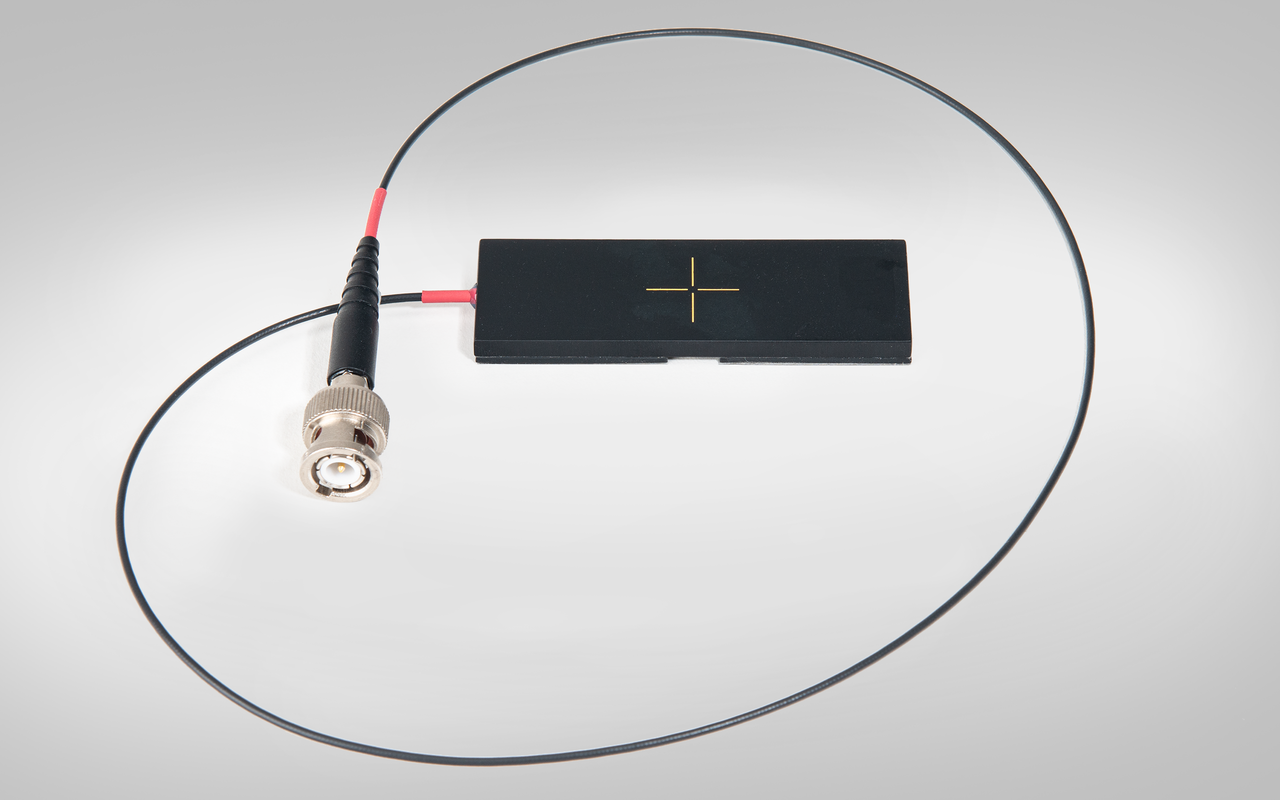
Microscopy quantum sensor for PPFD (photosynthetical photon flux density) measurement.
Operating temperature
- 5 °C … + 45 °C
Cable length
3 m
Connector

BNC

Size

Base plate: 12 mm x 7 mm x 1 mm (H x W x L)
Sensor housing 5 mm x 7.5 mm x 7 mm (H x W x L)
Diffuser diameter: 3 mm

Weight

26 g

Design of sensor

Microscopy quantum sensor for PPFD (photosynthetical photon flux density) measurement.

Sensor housing

Black anodized aluminum housing

Diffuser material

Resin with fluorescence dye

Signal detection

High stability silicon photovoltaic. Signal output typically 1.5 μA / (1000 μmol m-2 s-1)

Temperature coefficient of photodiode

0.01 %/K

Absolute calibration

± 5 %

Operating temperature

0 °C … + 40 °C

Cable length

55 cm

Connector

BNC

Power supply

Not required

Size

Height: 5.5 mm
Length: 76 mm
Width: 26 mm
Diffuser diameter: 0.2 mm

Weight
36 g
Application

Measurement of photosynthetic photon fluence rate in air or water

Connects to

E.g. ULM-500

Connector

BNC

Signal output

Typically -3.5 μA / (1000 μmol m-2 s-1) in air

Cable length
3 m
Size

Diameter: 1 cm

Length: 11 cm

Weight

62 g

WinControl-3 Software

General Features and Graphical User Interface

WinControl-3 represents the latest version of the WinControl software family. Presently, WinControl-3 operates the Universal Light Meter ULM-500 and JUNIOR-PAM fluorometers as well as the MONITORING-PAM system, MINI-PAM-II and MICRO-PAM heads.

If the ULM-500 is controlled by this software, the computer can be used as continuing data acquisition unit powering the ULM-500, so that its internal batteries will not be used up.

WinControl-3 is capable of long-term data acquisition (up to several months) allowing the user to define different sampling frequencies. Experimental protocols can be performed automatically with programmable batch-files.

The WinControl-3 software can also be used to enter calibration factors and sensor names in the ULM-500. In addition, the predefined application settings for the field use can be changed conveniently.